Try Our Recommended at-home Treatments for Dry Eye >>

Detecting Macular Degeneration: How We Use Optical Coherence Tomography (OCT) To Save Central Vision
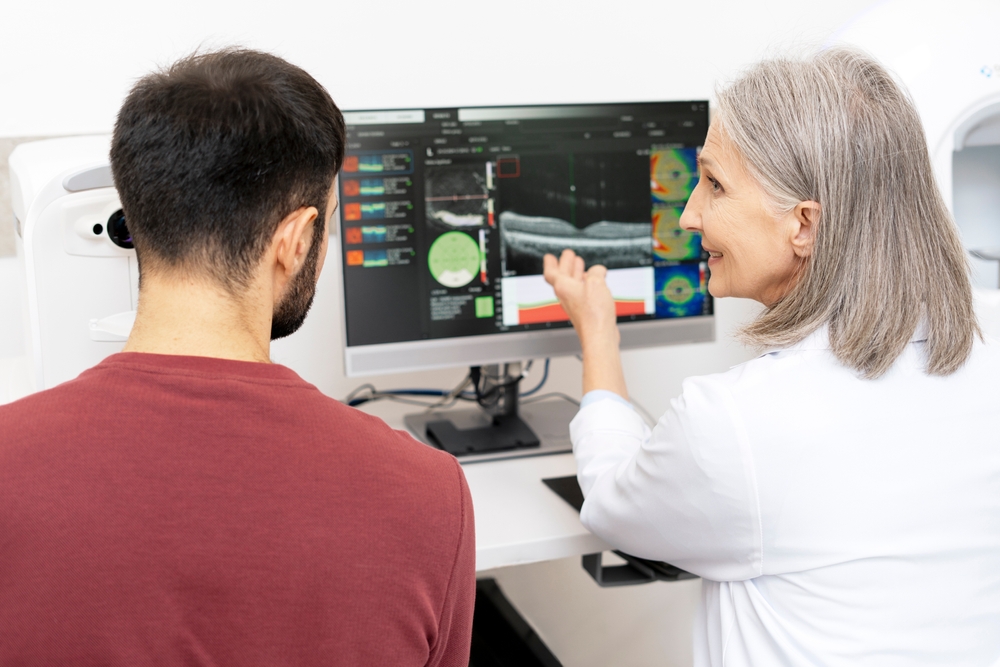
Detecting Macular Degeneration: How We Use Optical Coherence Tomography (OCT) To Save Central Vision
Macular degeneration can affect the part of your vision you rely on most for reading, driving, recognizing faces, and seeing fine detail. Because early changes may not cause obvious symptoms, advanced retinal imaging is an important part of protecting long-term eye health.
At inVista Optical in Indianapolis, we use optical coherence tomography, also known as OCT, to evaluate the macula in detailed layers. This technology helps us detect signs of macular degeneration earlier, monitor changes over time, and guide the next steps in your care.
What Is Macular Degeneration?
Macular degeneration is an eye disease that affects the macula, the central part of the retina responsible for sharp, detailed vision. It is most common in adults over 50, but risk can also be influenced by family history, smoking, UV exposure, and overall health.
While macular degeneration does not usually cause total blindness, it can make central vision blurry, distorted, or dark. That is why routine comprehensive eye exams in Indianapolis are so important, especially if you have noticed changes in your central vision.
How OCT Helps Us See Below The Surface
Optical coherence tomography creates high-resolution cross-sectional images of the retina. Instead of only viewing the surface of the eye, OCT allows our Indianapolis eye care team to examine the retinal layers beneath the surface.
This matters because macular degeneration can cause subtle structural changes before vision loss becomes noticeable. OCT can help identify fluid, thinning, thickening, or other changes that may need closer monitoring or referral for treatment.
Signs You Should Not Ignore
Macular degeneration symptoms can develop gradually, and one eye may compensate for the other. Schedule an eye exam if you notice:
• Blurry or fuzzy central vision
• Straight lines appearing wavy or distorted
• Difficulty reading small print
• Trouble recognizing faces
• Dark or blank spots in the center of your vision
• Needing brighter light for close-up tasks
These symptoms do not always mean you have macular degeneration, but they should be evaluated promptly.
The Importance Of Early Detection
When macular degeneration is found early, your optometrist can track changes and help you understand your risk. OCT imaging provides a detailed baseline, which makes it easier to compare future scans and identify progression.
For Indianapolis patients with early signs of macular degeneration, monitoring may include regular retinal imaging, lifestyle guidance, nutritional recommendations, and coordination with a retinal specialist when needed. The goal is to protect as much central vision as possible for as long as possible.
Advanced Eye Care In Indianapolis
At inVista Optical, OCT is part of our commitment to thorough, personalized eye care. Whether you have a family history of macular degeneration, have been diagnosed in the past, or simply want a deeper look at your eye health, advanced retinal imaging can provide valuable insight.
Schedule an eye exam with OCT at inVista Optical and stay ahead of macular degeneration before it affects your vision. Contact our office in Indianapolis, IN by calling (317) 929-1401 to book an appointment today.
Quick Links
Helpful Articles

All Eye Care Services
We go beyond standard eye exams to provide personalized healthcare tailored to your unique needs. Using advanced diagnostic tools, we ensure precise optical measurements for unmatched accuracy in your prescriptions and eyewear.

Keep In Touch
For non-urgent questions or to learn more about our services, contact us today!
© 2026 inVista Optical. All rights Reserved - Accessibility Statement - Privacy Policy - Sitemap
Managed and Designed by 